

Park · Leeds · ⭐ 9.5/10 · 2478 reviews · updated: 2026-08-04 20:21:00
Address: The Whitehouse Visitor Centre/Johnny La, Otley LS21 3JL, United Kingdom
Otley Chevin Country Park — the gritstone ridge that gave Leeds its horizon
The Chevin is the long, dark-edged escarpment that rises above Otley on the southern side of the Wharfe valley, and Otley Chevin Forest Park is the public estate that covers it. Its north-facing cliff climbs steeply to around 280 metres above sea level, with Beacon Hill, the true summit, reaching 283 metres — high enough that the whole valley, the town below and a long sweep of Wharfedale open out in a single glance. This is not a manicured city park. It is woodland, heath, rough meadow and bare Millstone Grit outcrop, laced with paths and bridleways, and it exists in public hands because one landowner decided in 1944 that the best possible war memorial was an open hillside that nobody could ever build on.
Highlights
- Surprise View — the park’s signature viewpoint and the reason most people come, delivering the whole of Otley and the Wharfe valley in one step out of the car park; it is not the highest point on the ridge, but it is the most dramatic.
- Beacon Hill — the actual summit at 283 metres (928 feet), on the ground above the old Yorkgate quarry, and the traditional site for signal and celebration fires.
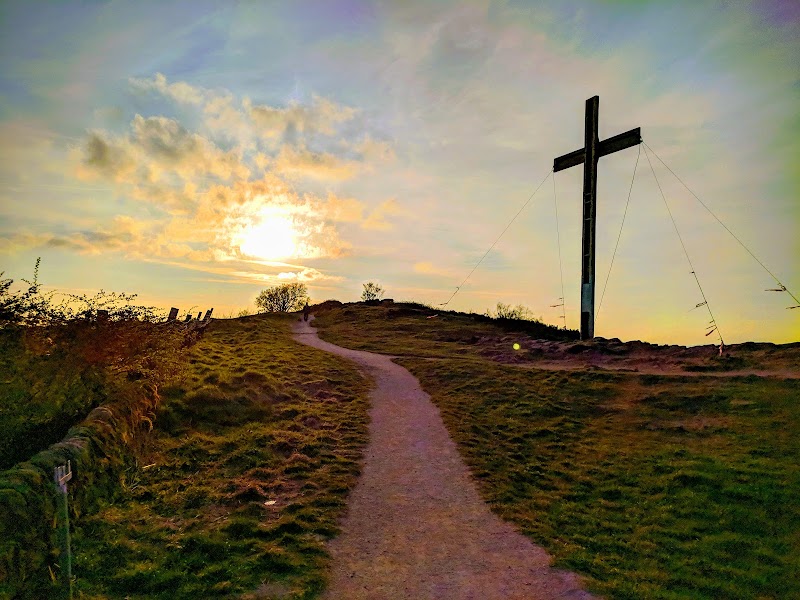
- The Easter cross — a cross has been raised at Surprise View every Easter since 1969, an unbroken local tradition now well past half a century old.
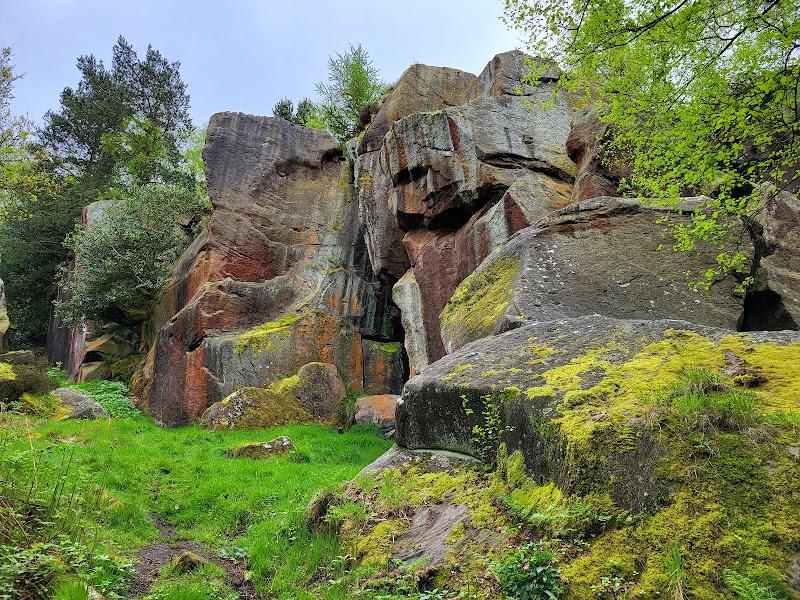
- The gritstone outcrops — weathered Carboniferous Millstone Grit crags and boulders scattered along the escarpment, long used by climbers and boulderers and the reason the ridge has its abrupt, stepped profile.
- The White House — the park’s visitor centre and café, run by adults with learning difficulties with the support of Leeds City Council’s adult services team; it has been the foresters’ base since 1999 and is dog-friendly.
- Yorkgate quarry — the workings that campaigners fought to stop between 1967 and 1973, added to the park in 1987 and now a habitat and quiet corner rather than an industrial site.
- The Danefield woods — the replanted heart of the park, where memorial stones stand among trees put in from the 1950s onwards to replace a plantation felled for the war effort.
What you’ll find
The Chevin is a working piece of countryside rather than a lawn with benches. Ground conditions change quickly — surfaced paths near the viewpoints, rooty woodland tracks in the middle, exposed rock and heather at the top — and so does the weather, which arrives from the west with very little warning at this height.
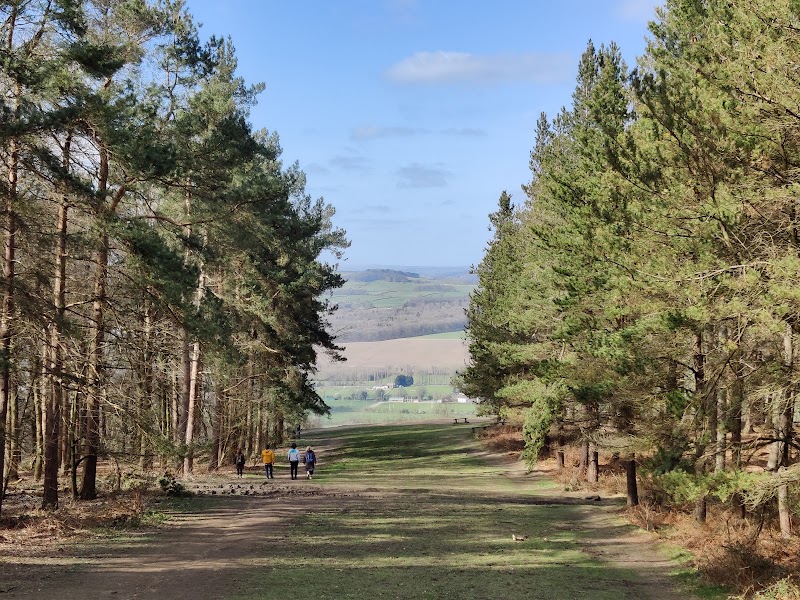
- Mixed woodland of relatively young trees: almost nothing here predates the war, because in June 1942 more than a thousand trees were sold off to timber merchants for the war effort, and the forest you walk through today grew from the replanting that followed.
- Heathland, rough meadow and bracken slopes on the upper ground, with rocky outcrops breaking through — four distinct habitats in a park you can cross in an hour.
- Wildlife adapted to that mix, including green hairstreak butterflies on the heathy edges and woodcock in the damper woodland; the ridge is also a good place to watch birds moving along the valley.
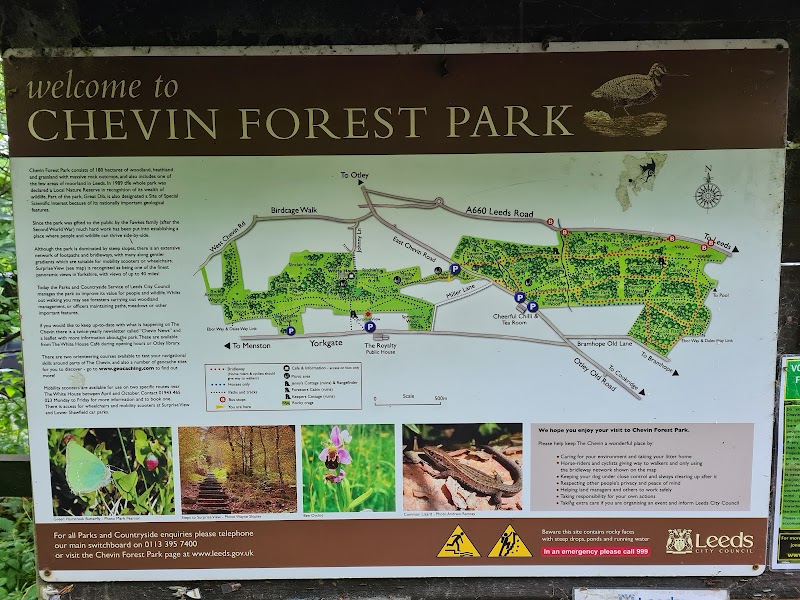
- Themed self-guided routes — a Geology Trail, a Heritage Time Trail and a tree-spotting route — plus orienteering courses maintained by the Friends of Chevin Forest Park.
- An extensive bridleway network on the eastern part of the ridge, catering to a range of abilities and open to riders and cyclists as well as walkers.
- Five car parks spread along the top and eastern side, an accessible viewpoint, and accessible toilet and changing facilities at the visitor centre during café hours.
Things to do — and who it’s for
- View-hunters and first-time visitors — Surprise View is a few steps from a car park and needs no walking ability at all; it is the single most efficient view in the Leeds district.
- Serious walkers — the full traverse of the ridge, from the eastern woods over the summit and back through Danefield, gives a genuinely hilly half-day within ten miles of a major city.
- Runners — a free timed 5km parkrun is held here on Saturday mornings, and it is emphatically not a flat one; local fell runners use the escarpment as a training gradient.
- Climbers and boulderers — the gritstone outcrops along the edge have been worked for generations and offer short, technical problems on rough, grippy rock.
- Riders and mountain bikers — the bridleways on the eastern side carry horses and bikes away from the busiest walking routes.
- Families and dog walkers — the woodland loops near the visitor centre are sheltered and manageable with small legs, and the café at the White House welcomes dogs.
Getting there & practical
The Chevin rises directly above the market town of Otley in Wharfedale, about ten miles north-west of Leeds city centre, and the park is entered from the top of the ridge rather than from the town. Otley itself has had no railway station since the 1960s, so the nearest stations are Menston and Burley-in-Wharfedale on the Wharfedale line between Leeds, Bradford and Ilkley; from either it is a bus or taxi hop to Otley. Frequent buses on the X84 and X85 services link Leeds with Otley bus station and continue up the valley to Ilkley, and Otley is also the hub for local Wharfedale routes. There are five car parks — three along the eastern approach and two at the old quarry — and the quarry car parks close at 6pm while the others stay open. Entry to the park is free and it is open all year; only the café at the White House keeps set hours, opening from 10am to 2pm Monday to Friday except Tuesdays, and 11am to 3pm at weekends. Allow an hour for the viewpoint and a short loop, or three to four hours to walk the ridge properly. Wear boots: the surfaced paths run out quickly.
When to visit
Spring is the clearest season for the view — the air is washed, the valley is green and the woodland floor is at its best before the canopy thickens — and it brings the Easter cross to the viewpoint. Summer turns the escarpment into a long, warm evening walk, with the heath in flower, green hairstreaks on the wing and light lasting until well after nine. Autumn is the colour season, when the replanted woodland turns and the valley below fills with morning mist that leaves the ridge standing above a white floor — the classic Chevin photograph. Winter is the connoisseur’s choice: bare trees make the geology legible, the exposed rock and heather take frost beautifully, and on a hard cold day the view runs further than at any other time of year. Bear in mind that the top is genuinely exposed, and that the wind up here is always stronger than in Otley.
Good to know
The name is older than English. It comes from the Brythonic language spoken here before the Anglo-Saxons, from the Celtic word for a ridge or a back — the same root as the Welsh “cefn” — and a Roman road once ran along the crest, using the ridge exactly as walkers use it now, as the driest and clearest line through the country. The rock underneath is Carboniferous Millstone Grit, the coarse sandstone that gives the Pennines their blunt edges and Yorkshire its building stone, and the quarries that scar the ridge were cut for exactly that.
The modern estate begins with the Otley enclosures of the 1780s, when common land where townspeople had grazed livestock, cut turf and peat and gathered stone and bracken passed into the hands of the Fawkes family of Farnley Hall. Walter Fawkes — the same family that would later host and patronise the painter J. M. W. Turner — laid out ambitious plantations in the late 1780s, and the woodland became known as Danefield. The Fawkes ran a deer park stocked with exotic game alongside it, and by the early 1900s a small toll booth was charging for access through the woods. The plantation’s end came on 1 June 1942, when 1,019 trees were sold to the timber merchants William Brear and Sons for £2,000 to feed the war effort, stripping the hillside almost bare. That is why very few trees on the Chevin are much more than seventy years old.
In August 1944 Major Le Gendre G. W. Horton-Fawkes wrote to Otley Urban District Council with an unusual proposal: instead of a conventional war memorial, he offered the Danefield estate — about 110 hectares, including the deer park — to the people of Otley as an open space to be planted with trees and kept in a natural state, in memory of everyone from the Wharfe valley who had fought. The land became publicly accessible for the first time since the 1780s enclosures, and the Chevin Forest Park was born. Reginald Rawling became the first Head Forester in 1956 and spent seventeen years turning a bald hillside back into woodland, laying out trackways, car parks and facilities before retiring in 1973; memorial stones from that replanting still stand among the trees, and his son Keith continued the work. The Surprise View and White House ground stayed in other hands until the Sam Chippendale Foundation bought it in 1972 and Leeds City Council purchased it for £15,000 in 1977, by which time the 1974 local government reorganisation had already transferred the whole park from Otley Urban District Council to Leeds. Yorkgate quarry was added in 1987 after a long public campaign against further extraction, the park was designated a Local Nature Reserve in 1989, and in 1999 the foresters moved out of the old Danefield cabins into the renovated White House, which now serves as the visitor centre.
Visitor tips
- Start at the viewpoint car park if the weather is doubtful — you bank the view first, and everything after that is a bonus rather than a wasted drive.
- Check the café hours before counting on lunch: the White House closes on Tuesdays and shuts in the early afternoon on weekdays, and there is nothing else on the ridge.
- The quarry car parks lock at 6pm, so if you want a sunset from the top in summer, park where there is open access instead and walk in.
Questions & answers
Is Otley Chevin Forest Park free? Yes — entry is free, the park is open all year, and the car parks are free too. Only the visitor centre café operates to set hours.
How high is the Chevin? The north-facing escarpment rises to around 280 metres above sea level, and Beacon Hill, the true summit, stands at 283 metres, or 928 feet.
Is Surprise View the highest point? No. It is the most popular and the most photographed, and it gives the fullest view of Otley and Wharfedale, but Beacon Hill above the old quarry is higher.
Can I get there without a car? Yes, with a little planning. Buses on the X84 and X85 run from Leeds to Otley bus station, and the nearest railway stations are Menston and Burley-in-Wharfedale on the Wharfedale line, since Otley lost its own station in the 1960s. From the town the climb up to the ridge is steep but short.
How long does it take to walk? A short woodland loop from the visitor centre takes under an hour. Walking the length of the ridge and returning through the Danefield woods is a comfortable half-day, and the ground is hilly throughout.
Is it suitable for wheelchairs or pushchairs? Partly. The main viewpoint is wheelchair accessible and there are accessible toilet and changing facilities at the visitor centre during café hours, but the woodland and summit paths are rough, rooty and steep in places.
Are dogs allowed? Yes, under control at all times, and off the lead only if they will reliably come back — this is grazing and wildlife country. The café at the White House is dog-friendly.
Why is the woodland so young? Because more than a thousand trees were felled and sold for timber in June 1942 for the war effort. Almost everything you walk through was planted from the 1950s onwards under the park’s first Head Forester, Reginald Rawling.
Photos
Show 1 more photos
Visitor reviews
Reviews last updated: 2026-08-04 20:21:00
Data is refreshed monthly. Sources: leedsname.com and editorial picks based on reviews.
If you want to get lost for a few hours, this is a beautiful place on earth to do it. Incredible views
This place is great. The views are just absurd. I came here from the USA, and we have nothing like this, so it took my breath away. It's also a great place for aviation fans like me to watch the planes at Leeds Bradford…
A real treat that combines breathtaking views, trails from "tarmacked", level and even, to more varied but well-maintained routes up and down the hillside, as well as "freestyle" options for the more adventurous.
The ma…
Good air, a good walk and great views, you won't see anything better in Yorkshire! I really enjoyed it!! Beware of the hill, but it's worth it at the top.
Lovely country park, nice sunny day, plenty of shade for Ollie.
Very hilly in places, with beautiful views over Otley from there, highly recommend.