

The history of Leeds is both turbulent and fascinating. Today, we’ve decided to delve into the past and share the story of how the city’s sewage system came into being. It might seem like a mundane aspect of life, one most people take for granted. However, there was a time in Leeds when there was no sewage system at all, leading to significant problems. Read more about it on the pages of leedsname.com.
Household Waste Was Thrown Onto the Streets
In 1831, Leeds had a population of 123,000, a significant increase from 53,000 in 1800. The city’s population was growing rapidly as more people arrived seeking jobs and better opportunities. To accommodate these people, small cottages were built, often lacking ventilation or toilets. Sometimes, people lived in windowless basement spaces. These structures were located in crowded courtyards and unpaved streets.
Household and human waste was thrown directly onto the streets, resulting in filth and an unbearable stench. This foul smell infiltrated homes as well.
This unsanitary environment was a breeding ground for infectious diseases. As a result, cholera outbreaks frequently occurred in Leeds. The first recorded death from cholera occurred in 1832. However, city authorities largely ignored the issue until middle-class residents and officials began to fall ill alongside workers.
The First Steps Toward a Sewage System
In the 1840s, commissions were established to investigate the causes of epidemics. The commissions found that homes lacked drainage systems, and waste from households was simply dumped onto the streets. Toilets were scattered haphazardly, and no one maintained them. Sewage collectors were rare in Leeds, and those that existed were owned by private enterprises. Waste from these collectors flowed directly into the River Aire. By the 1830s, water from the River Aire was unsuitable for drinking. However, during the same period, 2,000 homes were connected to a water supply system that sourced water from the river. This service, however, was only available to the wealthy.
Due to the unsanitary conditions, mortality rates were high. The average lifespan was 44 years, and for workers, it was only 19 years.
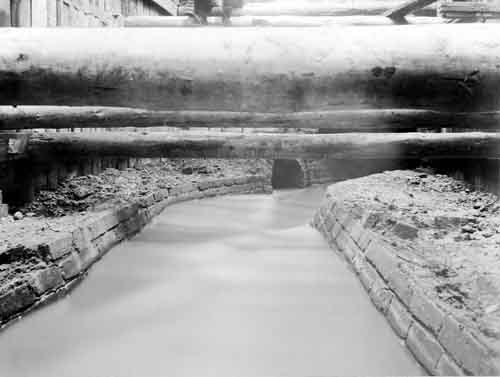
In 1842, Leeds was granted the right to build sewage collectors. Four years later, officials proposed engineer John W. Leather’s plan to use hydraulic, arterial, and water-based methods to transport sewage to the River Aire without treatment. Bureaucratic delays meant construction did not begin, and in 1849, another cholera outbreak claimed 200 lives.
By 1850, initial construction plans were approved. Two years later, Leeds Corporation purchased Leeds Waterworks Company. The city’s sewage system became operational, although residents were initially hesitant to connect to the new networks. As a result, piles of manure could still be found on Leeds streets for years.
Alongside the sewage system, the city also expanded its water supply network. By the end of the 19th century, 100,000 homes had access to water, though only 15,000 had toilets.
In the 1860s, plans were developed to extend the sewage network to areas such as Armley, Wortley, Headingley, Chapel Allerton, and Potternewton. However, not all these plans materialized. In 1869, dumping waste into rivers was prohibited, and waste had to be “treated or deodorized” before disposal.
By the 1950s, Leeds’ sewage system was overwhelmed and deteriorating. This affected public health, prompting the development of a new system that separated rainwater drainage from sewage to reduce strain on the network.
In 1974, ownership of the sewage system was transferred to Yorkshire Water. Sewage treatment became centralized, and Leeds City Council ceased managing the system in 1997.
Sewage systems exist in nearly every city, and it’s hard to imagine a time when waste was dumped directly onto the streets. Here are some fascinating facts about sewage systems:
- Ancient Rome had sewage systems. Historians note that sewer manholes were used over 2,000 years ago, but the innovation didn’t spread further.
- In 1270, French King Louis IX enacted a law prohibiting waste disposal from upper floors. Instead, residents had to carry waste to the ground floor.
- Sewer manholes were once made of cast iron or steel. Over time, these materials were replaced because manhole covers were frequently stolen. Today, they are made of plastic, concrete, or rubber.
- In 2011, a crocodile was found in a sewer in Cairns, Australia. The reptile was seen leaping onto the streets and startling passersby.